How you think about your life determines what you own in it.
The Ownership Mindset is a free resource from America's Holding Company — built on the belief that before you can own something financially, you have to own your thinking. How you approach your time, your decisions, your relationships, and your money all determines whether you end up an owner or just another person who paid in and got nothing back.
No course. No paywall. No upsell. Just real thinking from someone who's still on the road, sharing what they're learning as they go.
Not a tax course. A life operating system.
The Ownership Mindset started as a tax strategy program — the idea that if people understood how money actually works, they'd keep more of it. But the deeper we got into it, the clearer it became: the tax strategy starts upstream, in how you think and how you live.
So that's what this became. A framework for building a life you actually own — financially, mentally, and in every way that matters.
- How to think about money and time together
- Goal setting and long-term thinking
- Commitment and avoiding the shiny object trap
- Building a positive, resilient mindset
- Authenticity and showing up as yourself
- Tax strategy and keeping more of what you earn
- What ownership really means — in life and in business
Own your mind. Own your money. Own your future.
Everything in the Ownership Mindset connects back to one of three ideas.
Own your mind
Your mindset determines everything downstream. Happiness, commitment, attitude, authenticity — these aren't soft topics. They're the foundation of every financial and life outcome you'll ever have.
Own your money
Understanding how money works — how to keep more of it, how to make it work for you, and how tax strategy fits into a long-term wealth plan — is not optional. It's a responsibility every person owes themselves.
Own your future
Goals, legacy, and the long game. This is about playing a game that outlasts you — building something your kids and your community can benefit from long after you're gone. That's what AHC is. That's what the Ownership Mindset points toward.
I'm not teaching from a textbook. I'm teaching from the road.
I went through a divorce. I tried and failed at multiple businesses. I stocked shelves at midnight. I'm 39 years old with three kids and a dream that most people think is crazy. Everything I share in the Ownership Mindset comes from actually living it — the wins, the losses, and everything in between.
This is free because I believe financial and life education should be free. You shouldn't have to pay someone to tell you how to think about your own life. Take what's useful. Leave what isn't. And if it resonates — come own a piece of what we're building.
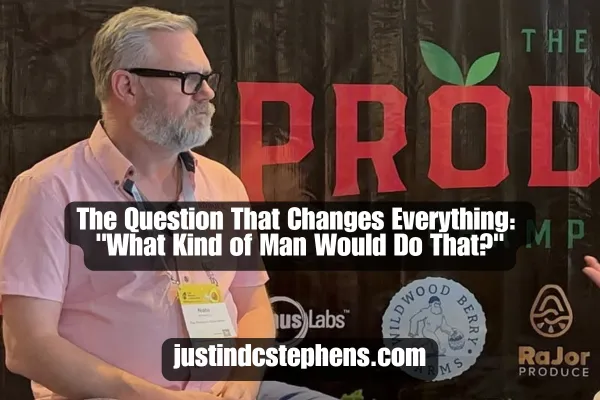
The Question That Changes Everything: "What Kind of Man Would Do That?"
Ten years ago, Nate Montgomery looked in the mirror and didn't like who was looking back. What he did next didn't happen overnight — and that's the part most people skip.
I sat down with Nate Montgomery — founder of Produce Champion and a man who's spent almost 20 years building a media company around one idea: that produce is people. Before we got into ownership, he told me about his mission — increasing awareness of fresh fruits and vegetables, and creating a marketplace for small and medium growers who'd otherwise get squeezed out. It's a good business. But that's not why I wanted him on.
I wanted him on because Nate hit bottom over a decade ago — physically, spiritually, morally — and had to rebuild from there. And the way he described that rebuild is the clearest definition of ownership I've heard on this show.
Here's what surprised me most: Nate didn't just own his mistakes. He owned his ADHD. He owned growing up poor. Things most people spend a lifetime treating as liabilities, he decided to treat as superpowers instead. Not because it sounded good on a podcast — because he'd already done the harder work of owning the damage he'd caused first. You don't get to claim the superpower until you've claimed the wreckage.
That's the order most of us get backwards. We want to skip to "my struggle is my strength" without ever sitting in the room with what the struggle actually cost other people.
The gap Nate pointed to next is the one that stuck with me. He said most people think accountability means finding someone to babysit them — someone to stand over their shoulder and stop them from screwing up again. He called that what it is: being a baby. Real accountability, he said, is naming your own weakness, building your own plan, and reporting back on your own progress. Nobody's holding the leash. You are.
Then he gave me the question I haven't stopped thinking about since: What kind of man would do that?
Not "why did I do that" — which turns into excuses fast. Not "how do I fix the optics." Just: what kind of man does this thing I'm about to do, or just did? It's a filter you can run before you speak, before you react, before you check out on something that matters. And Nate uses it both directions — when he's tempted to do wrong, and when someone wrongs him. Because most people aren't out here trying to hurt each other. They're distracted, hurting, or having the worst day of their year. That one question buys you the pause to consider that.
Here's where time comes in, because it always does. Nate didn't say any of this got easier fast. He said ownership is hard at the beginning and gets easier the more you practice it — which is just an honest way of saying it takes time and reps, not a weekend and a mantra. He's still working on it. At the end of our conversation, he told me flat out: he wants to be better with his time, better at following up on relationships, and he owns that he isn't there yet. That's not weakness talking. That's a 20-year business owner still doing the accounting on himself.
This week, before you defend yourself, correct someone, or beat yourself up over a mistake, try Nate's question first: what kind of man would do that? Not to shame yourself into silence — to give yourself one honest beat before you decide who you're going to be in the next five minutes. That's where ownership actually starts. Not in the grand gesture. In the pause.

The mindset is free. The ownership is $27 a month.
Read everything here for free. And when you're ready to turn the thinking into something real — subscribe and start building your stake.
Follow Justin Stephens with AHC On Social Media





America's Holding Company Inc.