
How you think about your life determines what you own in it.
The Ownership Mindset is a free resource from America's Holding Company — built on the belief that before you can own something financially, you have to own your thinking. How you approach your time, your decisions, your relationships, and your money all determines whether you end up an owner or just another person who paid in and got nothing back.
No course. No paywall. No upsell. Just real thinking from someone who's still on the road, sharing what they're learning as they go.
Not a tax course. A life operating system.
The Ownership Mindset started as a tax strategy program — the idea that if people understood how money actually works, they'd keep more of it. But the deeper we got into it, the clearer it became: the tax strategy starts upstream, in how you think and how you live.
So that's what this became. A framework for building a life you actually own — financially, mentally, and in every way that matters.
- How to think about money and time together
- Goal setting and long-term thinking
- Commitment and avoiding the shiny object trap
- Building a positive, resilient mindset
- Authenticity and showing up as yourself
- Tax strategy and keeping more of what you earn
- What ownership really means — in life and in business
Own your mind. Own your money. Own your future.
Everything in the Ownership Mindset connects back to one of three ideas.
Own your mind
Your mindset determines everything downstream. Happiness, commitment, attitude, authenticity — these aren't soft topics. They're the foundation of every financial and life outcome you'll ever have.
Own your money
Understanding how money works — how to keep more of it, how to make it work for you, and how tax strategy fits into a long-term wealth plan — is not optional. It's a responsibility every person owes themselves.
Own your future
Goals, legacy, and the long game. This is about playing a game that outlasts you — building something your kids and your community can benefit from long after you're gone. That's what AHC is. That's what the Ownership Mindset points toward.
I'm not teaching from a textbook. I'm teaching from the road.
I went through a divorce. I tried and failed at multiple businesses. I stocked shelves at midnight. I'm 39 years old with three kids and a dream that most people think is crazy. Everything I share in the Ownership Mindset comes from actually living it — the wins, the losses, and everything in between.
This is free because I believe financial and life education should be free. You shouldn't have to pay someone to tell you how to think about your own life. Take what's useful. Leave what isn't. And if it resonates — come own a piece of what we're building.
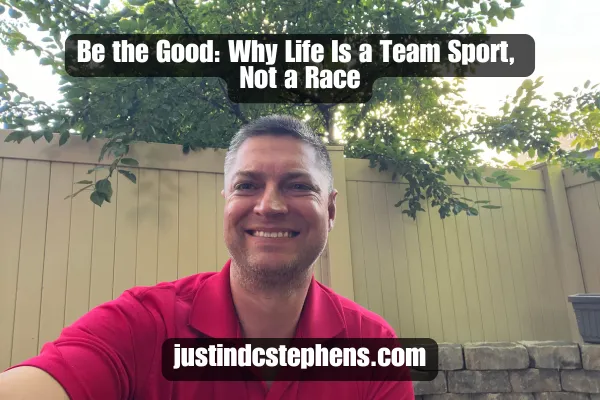
Be the Good: Why Life Is a Team Sport, Not a Race
I've been thinking a lot lately about how short this whole thing actually is.
Not in a dark way. In a wake-up-call way. We get one shot at this life, on a planet that's smaller than we like to admit, surrounded by people who are all trying to figure out the same thing we are — how to make this time mean something.
And somewhere along the way, a lot of us got it twisted. We started treating life like a competition. Like the goal is to get ahead of people instead of getting ahead with them.
I don't buy that anymore.
No One Has the Map
Here's something I remind myself constantly: nobody actually knows what's coming.
There are no fortune tellers. No time travelers. No one walking around with the answer key to their own future, let alone yours. Everybody you pass at the grocery store, everybody you scroll past online, everybody sitting across the table from you — they're all guessing. Adjusting. Trying things and hoping they work out.
We all carry opinions like they're facts. We talk about the future like we've seen it. But really, that's all any of us have — ideas, theories, best guesses dressed up as certainty. Once you actually sit with that, it changes how you look at people.
Because if nobody knows what they're doing, then the guy struggling next to you isn't your competition. He's your teammate. Same boat, same fog, same lack of a map. The only real difference between us is what we choose to do with the not-knowing.
Better Than Everyone vs. Better To Everyone
I used to think the goal was being better than the people around me. Better than my last result. Better than the next guy in the room.
I'm shifting that. The goal isn't being better than everyone. It's being better to everyone.
That one word changes everything.
"Better than" puts you in a race where someone has to lose for you to win. "Better to" puts you on a team where everyone can win at the same time. One is scarcity. The other is multiplication.
And the wild part? Being better to people doesn't cost you anything you can't afford. It doesn't require money, status, or a big platform. It requires attention. A decision. A few seconds of choosing someone else over your own scroll, your own hurry, your own self-interest.
The Free Stuff Is the Powerful Stuff
Some of the most valuable things you can give another human being cost you nothing:
A genuine "how are you, really?"
Actually listening to the answer.
A smile at a stranger who looks like they're carrying something heavy.
Letting someone merge. Letting someone go first. Letting someone vent.
Telling someone, specifically, what you respect about them — before they ask, before they doubt it.
None of that shows up on a balance sheet. But all of it shows up in someone's day. You don't know what kind of morning the cashier had, what the guy in the next car is driving home to, what the person across the table is quietly fighting through. You might be the only kind interaction they get all day. That's not a small thing. That might be the biggest thing that happens to them today.
Be the Change, On Purpose
There's a phrase that gets thrown around so much it's almost lost its weight: be the change you want to see in the world. But strip away the bumper-sticker feel of it, and it's actually a pretty serious instruction.
It's not asking you to wait for the world to get kinder so you can match it. It's asking you to go first. To set the tone instead of reacting to it. To build the kind of environment you want to live in, one interaction at a time, instead of hoping someone else builds it for you.
That's a decision. Not a feeling. A decision you make on purpose, probably more than once a day, especially on the days it would be easier not to.
And here's the thing about that decision — it compounds. A life of real fulfillment isn't built in one big moment. It's built the same way everything worth having gets built: small, consistent choices, stacked over time, pointed in the same direction.
What You Put Out Tends to Come Back
I'm not going to pretend I have this all figured out. But I've lived long enough to notice a pattern: when you put good into the world — genuinely, without keeping score — it has a way of finding its way back to you. Not always immediately. Not always from the same person you gave it to. But it comes back.
Call it karma. Call it momentum. Call it the simple math of how people remember how you made them feel. Whatever you call it, it's real, and it's one of the better-kept secrets in life: kindness isn't just good for the other person. It's good business for your own future, even if you never collect on it directly.
The Invitation
So here's what I'm putting out there today: look at the people around you — at work, online, in line at the store — not as competition, but as teammates on the same short, confusing, beautiful ride. Nobody up ahead can tell you what's coming. So stop trying to win against the people next to you, and start figuring out how to win with them.
Say the kind word. Give the smile. Let someone merge. It costs you almost nothing, and it might be exactly what someone needed today.
Be the good. The world's got plenty of room for more of it.
#TimeIsEverything #NeverSettle #BuildingInPublic

The mindset is free. The ownership is $27 a month.
Read everything here for free. And when you're ready to turn the thinking into something real — subscribe and start building your stake.
Follow Justin Stephens with AHC On Social Media






America's Holding Company Inc.